AI Platform Engineer

Ade
Daramola

Nearly two decades engineering cloud, database, and distributed systems. Today I build cloud-native AI platforms that combine multi-provider LLM inference, retrieval-augmented generation, agentic workflows, Kubernetes, security, and observability — with deterministic safeguards around probabilistic systems.

// AWS · Kubernetes · Terraform · Python · LLM Platforms · RAG · Agentic AI · Model Engineering

See My Work GitHub ↗ Get in Touch
Scroll
The Story

Production
discipline. Applied to AI.

I started in 2007 managing Oracle databases for defense and enterprise clients, where performance, recovery, and data integrity were operational requirements rather than design preferences. That foundation shaped how I approach every system I build.

I then spent years designing and operating AWS infrastructure for government and commercial workloads, moving from database engineering into cloud architecture, infrastructure as code, CI/CD, security controls, and distributed systems.

At Zolon Tech, I work across multi-account AWS environments, EKS, Terraform, security controls, delivery automation, and complex production incident response. The common thread is reliability: understand the failure mode, remove the root cause, and build controls that prevent recurrence.

My AI platform work extends that discipline into probabilistic systems. I engineer LLM gateways, RAG services, human-reviewed agent workflows, model-specialization pipelines, and cross-service observability as deployable systems with explicit security boundaries, evaluation, failure isolation, and measurable behavior.

2007
Engineering Career Started
4
Repos in the OpsDesk Platform
4
Industry Certifications
0.892
Best Field F1 · Q8 GGUF

AI Platform Engineering

Deployed systems.
Measured behavior.

Project 01 · Flagship Platform
OpsDesk
Cloud-Native AI Support Operations
Flagship Architecture

Four repositories. One integrated AI platform.

OpsDesk is intentionally split across independently deployed application, retrieval, inference, and cloud-platform repositories. The boundaries keep each system independently testable and deployable while authenticated APIs, queues, and trace context connect the end-to-end workflow.

Repo 01 · Product
ops-platform
FastAPI application, authentication, ticketing, AI workflows, CPU Agent, APIs, migrations, and UI.
Repo 02 · Retrieval
rag-platform
Hybrid dense + BM25 retrieval, RRF, parent-child expansion, reranking, and bounded citation evidence.
Repo 03 · Inference
multi-llm-platform
Serverless LLM routing across Bedrock, Anthropic, and OpenAI with auth, fallback, usage, and cost controls.
Repo 04 · Cloud Platform
eks-observability-platform
AWS networking, EKS, RDS, ECR, SQS/DLQ, IAM, ingress, encryption, monitoring, and operations.

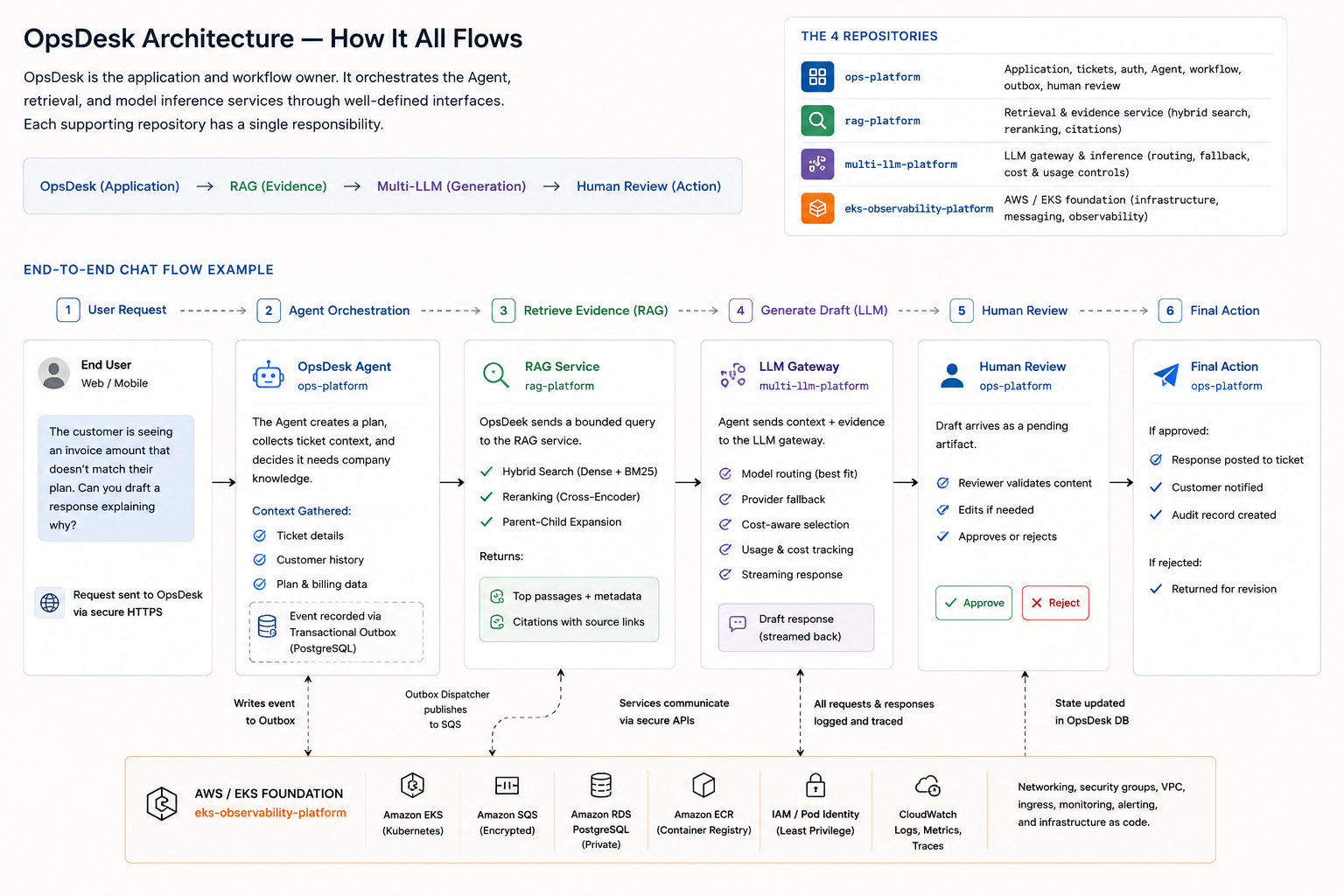
Application → durable AI workflow → authenticated retrieval → multi-provider generation → human review. The platform is deployed on AWS with infrastructure-as-code, independent service boundaries, privacy-aware telemetry, and end-to-end correlation across HTTP, PostgreSQL, SQS, RAG, and Lambda.

OpsDesk architecture flow showing how ops-platform orchestrates RAG retrieval, multi-LLM generation, human review, and the AWS EKS observability platform
End-to-end OpsDesk flow: the application owns workflow state, RAG supplies bounded evidence, the multi-LLM gateway performs model inference, and the AWS/EKS platform provides runtime infrastructure and observability.
The engineering problem: AI features should not become a new availability, privacy, or control-plane dependency for the core application. OpsDesk treats AI as an asynchronous capability behind explicit service boundaries: the support product remains functional when Agent, retrieval, model, or telemetry dependencies are unavailable, and generated content cannot reach a customer-facing ticket without authorized human review.

How the four repositories work together: ops-platform owns the user-facing application and AI workflow. Its CPU-based Agent orchestrates the AI request without direct database credentials. When ticket context needs organizational knowledge, the Agent calls rag-platform through an authenticated retrieval API; that service performs hybrid retrieval and reranking and returns bounded evidence with citation metadata rather than owning final generation. The Agent then sends the assembled context to multi-llm-platform, which provides the model-inference boundary: authentication, cost-aware routing, provider fallback across Amazon Bedrock, Anthropic, and OpenAI, usage accounting, and privacy-aware cache controls. eks-observability-platform supplies the AWS runtime beneath the workflow—networking, EKS, RDS PostgreSQL, ECR, SQS/DLQ, IAM, ingress, encryption, monitoring, and cross-system observability. OpsDesk owns the workflow; RAG supplies evidence; Multi-LLM performs generation; EKS Observability runs and monitors the platform.

OpsDesk is a server-rendered support-ticket and knowledge-management application built with Python, FastAPI, PostgreSQL, Docker, Kubernetes, and AWS EKS. The application implements role-based workflows, audit history, search, optimistic concurrency, secure sessions, CSRF protection, and object-level authorization. AI work is dispatched through a transactional outbox → Amazon SQS → CPU-based Agent path, so database state and work publication remain durable and independently retryable.

The Agent has no direct database credentials. It receives a minimized workflow payload, optionally retrieves bounded evidence from the authenticated RAG service, and sends the final generation request through the separate Multi-LLM gateway. Citation identifiers are validated before persistence, and every generated draft remains pending until a reviewer explicitly approves and applies it.

The RAG path combines dense retrieval and BM25, Reciprocal Rank Fusion, parent-child context expansion, and CPU cross-encoder reranking. In the deployed benchmark it achieved 100% source-level Precision@1 and Recall@5 across 55 answerable queries. Exact and semantic caching produced a 90.91% cache-hit rate and reduced warm median retrieval latency 36.8× — from about 9.0 seconds to 245 ms.

The serverless LLM gateway routes across Amazon Bedrock, Anthropic, and OpenAI with cost-aware selection, provider fallback, API-key controls, per-client usage accounting, privacy-aware cache policies, and SSE streaming. A validated live workflow used Bedrock Nova Micro successfully on the first attempt at an estimated cost of approximately $0.000018, while the generated response still remained behind human review.

The AWS platform is Terraform-managed across a two-AZ VPC with private EKS workloads, isolated RDS PostgreSQL, ECR, encrypted SQS/DLQ, ALB, Route 53, ACM, KMS, Secrets Manager, EKS Pod Identity, CloudWatch, and X-Ray. OpenTelemetry, Prometheus metrics, structured JSON logs, and W3C trace context propagate workflow correlation across service boundaries without making telemetry a readiness dependency.
✓ 4 independently deployed repositories ✓ 357 passing tests across integrated services 100% source-level P@1 · R@5 36.8× warm RAG latency improvement
Python · FastAPI AWS EKS · Kubernetes PostgreSQL · SQLAlchemy Terraform Amazon SQS · Transactional Outbox Amazon Bedrock · Anthropic · OpenAI Hybrid RAG · BM25 · Dense · RRF Cross-Encoder Reranking OpenTelemetry · Prometheus CloudWatch · X-Ray IAM · Pod Identity · KMS GitHub Actions · Trivy · Bandit
Project 02
LLM Specialization Platform
Model Adaptation · Evaluation Infrastructure
The engineering problem: Fine-tuning is only useful if the artifact that ships is reproducible, measurable, and protected against silent data and export failures. The pipeline therefore evaluates the full artifact lifecycle rather than treating a successful training run as the finish line.

The platform specializes Qwen2.5-7B-Instruct for structured extraction through QLoRA supervised fine-tuning, DPO preference alignment, frozen-test evaluation, BF16 model merging, and GGUF quantization. Versioned manifests capture Git revision, dependency locks, dataset hashes, and hardware fingerprints so every run can be traced back to the exact inputs that produced it.

On the frozen 377-example test set, the base model scored 0.000 Field F1. SFT reached 0.884, DPO reached 0.885, and the exported Q8 GGUF artifact reached 0.892 Field F1, with 100% schema validity and 100% null accuracy across shipped artifacts. MMLU and HellaSwag regression checks also passed.

The most important result came from the data pipeline: v1 labels were only 54% grounded in the source text and capped Field F1 around 0.47. Relabeling the same input texts under a strict grounding contract raised performance to 0.885 with no model or hyperparameter changes. The pipeline now fails label-audit checks before training when grounding falls below the configured threshold.

✓ 0.000 → 0.892 Field F1 377-example frozen test set 100% schema validity · null accuracy
Python · PyTorch Qwen2.5-7B-Instruct QLoRA · SFT · DPO vLLM · llama.cpp Hugging Face · PEFT · TRL BF16 · GGUF Q8_0 · Q4_K_M CUDA · A100 MMLU · HellaSwag Docker · GitHub Actions
Project 03
GitOps Auto-Remediation
Confidence-Gated AI Operations
The engineering problem: Operational automation needs stronger controls as the action becomes more consequential. This portfolio MVP explores how AI-assisted incident reasoning can remain bounded by deterministic confidence scoring, approved actions, Git review paths, validation, and rollback instead of granting an LLM direct mutation access to a Kubernetes cluster.

The system uses seven Python Lambda functions, Step Functions, Bedrock/OpenAI, EventBridge, DynamoDB, S3, and EKS to ingest alerts, classify incidents, analyze likely root cause, propose bounded actions, and calculate deterministic confidence and risk before choosing a route.

Git and Argo CD remain the workload mutation path. HMAC-authenticated alert intake, deduplication, audit records, Prometheus outcome validation, and automatic revert PRs provide controls around the AI-generated plan. The infrastructure is organized across 20 Terraform modules and validated with 123 automated tests.

ConfidenceRiskRoute
≥ 80LowEligible for bounded automated path
40 – 79AnyPull request for engineer review
< 40AnyEscalate without applying a change
✓ 123 automated tests 7 Lambda functions 20 Terraform modules
Python AWS Lambda · Step Functions Amazon Bedrock · OpenAI Terraform · Argo CD Kubernetes · EKS EventBridge · DynamoDB · S3 Prometheus HMAC · Audit Trail · Auto-Revert

Career Arc

From database reliability
to AI platforms

2020 – Present
Senior Cloud Engineer
Zolon Tech Inc.

I architect and operate AWS infrastructure across five accounts in a federal government environment, using Amazon EKS and Terraform to deliver secure, repeatable cloud platforms. My work spans infrastructure modernization, CI/CD, least-privilege IAM, network segmentation, centralized logging, and STIG-aligned security controls.

A representative reliability problem involved an Aurora failover where the database recovered in 35 seconds but the application remained unavailable for roughly 40 minutes. I traced the fault to JVM DNS caching and stale connection-pool targets, corrected TTL and connection-lifetime behavior, and added synthetic write validation. Two subsequent failovers completed without application-visible disruption.

Nov 2012 – Nov 2020
Database Engineer → Senior Cloud Engineer
Viper Technology Services, LLC

I progressed from database engineering into cloud engineering as workloads moved to AWS, carrying production availability, recovery, and failure-management experience into cloud architecture. I designed VPC and network environments, standardized infrastructure provisioning with Terraform and CloudFormation, and automated delivery with Jenkins, Ansible, Python, and Bash.

The work also included IAM governance, security controls, and centralized audit logging for government and commercial environments — the automation and infrastructure foundation I now apply to AI platform engineering.

2007 – 2012
Oracle DBA / Analyst
CACI International Inc. & Apptis, Inc.

I administered and tuned Oracle environments for defense and enterprise clients, covering performance optimization, backup and recovery, high availability, and 24/7 operational support. That work established the reliability and failure-analysis discipline that still anchors how I design cloud and AI systems.

Technical Skills

AI platform engineering
end to end

AI Platforms & LLMOps
Amazon BedrockAnthropic Claude OpenAIMulti-provider routing Provider fallbackToken & cost accounting Semantic cachingSSE streaming Human-in-the-loop AI
RAG & Retrieval
Dense vector searchBM25 Reciprocal Rank FusionCross-encoder reranking Parent-child chunkingCitation grounding WeaviateChromapgvector
Cloud & Platform Engineering
AWSEKSKubernetes LambdaAPI Gateway RDSSQS / DLQDynamoDB ECRALBTerraform
Reliability, Observability & Security
OpenTelemetryPrometheus CloudWatchAWS X-Ray W3C trace contextStructured logging IAMEKS Pod Identity KMSSecrets ManagerRBAC
Software & Distributed Systems
PythonFastAPI SQLAlchemy 2PostgreSQL 17 AlembicPydantic REST APIsTransactional outbox Optimistic concurrencyEvent-driven architecture
Model Engineering & Delivery
QLoRASFTDPO vLLMllama.cppGGUF DockerGitHub Actions pytestRuffmypy BanditTrivyDeepEval

Certifications

Validated
across domains

🟢
NVIDIA-Certified Professional — Agentic AI
NVIDIA · Advanced
🟢
NVIDIA-Certified Professional — Generative AI (LLMs)
NVIDIA · Advanced
🟠
AWS Certified Solutions Architect — Associate
Amazon Web Services
🟣
HashiCorp Certified: Terraform Associate
HashiCorp
Let's Talk

Building serious
AI platforms

I’m interested in AI Platform Engineer, AI Infrastructure, and AI Platform Architecture roles where cloud engineering discipline and modern LLM systems meet. If you’re building systems that need secure service boundaries, reliable infrastructure, measurable retrieval and model behavior, and operational visibility from request to outcome, I’d like to hear about it.